


UAE e-Invoicing is set to transform how businesses create, exchange, and report invoices for VAT and tax compliance. As part of the UAE’s digital tax strategy led by the Ministry of Finance, e-Invoicing will become mandatory for businesses operating in the country.
This blog explains UAE e-Invoicing, how it works, why it matters, and how it relates to global frameworks such as Peppol. It is written for business owners, finance teams, and decision-makers who want clarity without unnecessary technical complexity.
What is UAE e-Invoicing?
UAE e-Invoicing refers to the creation, transmission, and reporting of invoices in a structured electronic format that can be automatically processed by accounting systems and government platforms.
Instead of sending invoices as PDFs or paper documents, businesses generate invoices in machine-readable formats such as XML or UBL. These invoices contain structured data fields that allow validation of VAT, invoice totals, supplier details, and buyer information.
UAE e-Invoicing enables tax authorities to receive transaction data digitally, supporting real-time or near real-time VAT compliance.
Why UAE e-Invoicing Is Being Introduced
The UAE government is introducing e-Invoicing to modernise tax administration and improve VAT transparency across all sectors.
The UAE government is making e-invoicing mandatory by July 2026 for businesses that pay VAT.
Key objectives include:
- Strengthening VAT compliance
- Reducing fake invoices and tax fraud
- Increasing accuracy of tax reporting
- Automating audit and verification processes
- Aligning the UAE with global e-Invoicing standards
Many countries have already adopted e-Invoicing, and the UAE is following a proven global model.
What UAE e-Invoicing Is Not
Understanding what e-Invoicing is not is equally important:
- It is not a PDF invoice sent by email
- It is not a scanned paper invoice
- It is not manual data entry into a portal
Only structured, system-generated invoices qualify as valid e-Invoices.
How UAE e-Invoicing Works
UAE e-Invoicing follows a structured digital flow where invoice data moves securely between systems.
Step 1: Invoice Creation
The supplier creates an invoice in their ERP, accounting, or billing system. The invoice includes:
- Supplier and buyer details
- Invoice number and issue date
- Line items, quantities, and values
- VAT rates and tax amounts
At this stage, the invoice exists as business data within the supplier’s system.
Step 2: Invoice Standardisation and Validation
The invoice data is converted into a structured electronic format compliant with UAE e-Invoicing requirements. Validation checks ensure:
- Mandatory fields are present
- VAT calculations are accurate
- Data follows defined standards
Step 3: Secure Invoice Exchange
The validated e-Invoice is transmitted securely through an approved network or service provider. The system ensures the invoice reaches the correct recipient without data manipulation.
Step 4: Buyer Receipt and Processing
The buyer receives the e-Invoice directly into their accounting or ERP system. This eliminates manual data entry and accelerates approval and payment cycles.
Step 5: Tax Authority Reporting
Relevant tax data from the invoice is shared with the UAE tax authority as required. This supports continuous transaction monitoring and VAT compliance.
UAE e-Invoicing and the 5-Corner Model
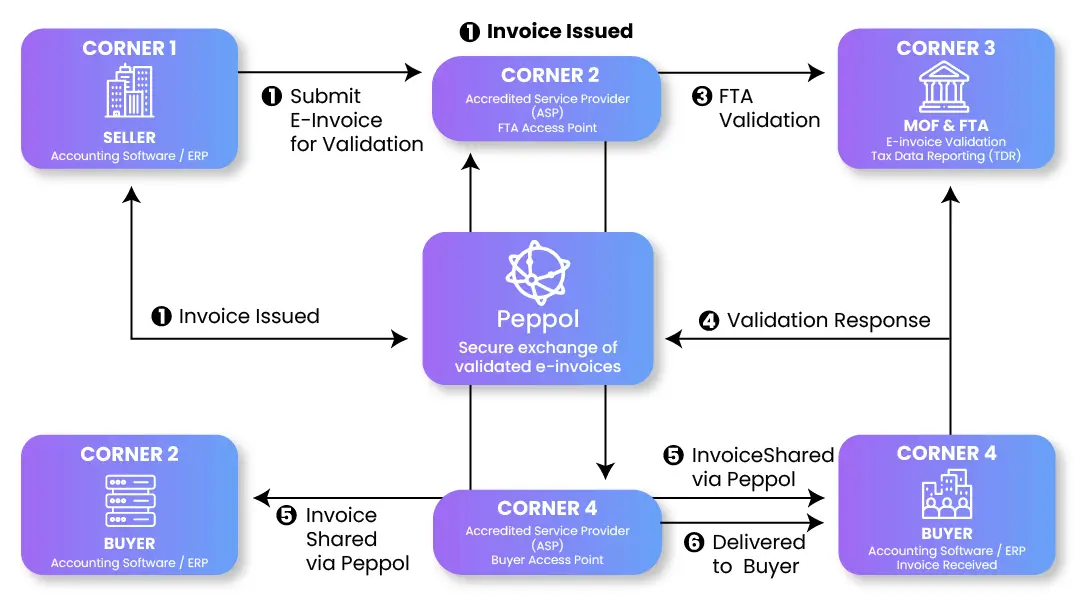
UAE e-Invoicing aligns with the global 5-Corner Model, which includes the tax authority as an additional participant in the invoice flow.
The model includes:
- Supplier
- Supplier’s service provider
- Secure exchange network
- Buyer’s service provider
- Tax authority
This structure allows invoices to flow between businesses while tax data is simultaneously made available to the government.
Relationship Between UAE e-Invoicing and Peppol
Peppol is a global e-Document exchange network used by many countries for e-Invoicing and procurement.
While UAE e-Invoicing is country-specific, it follows similar principles to Peppol, including:
- Standardised invoice formats
- Certified service providers
- Secure routing of invoices
- Automated validation
Understanding Peppol helps businesses prepare for UAE e-Invoicing, especially those operating internationally.
Benefits of UAE e-Invoicing for Businesses
Although mandatory compliance is the main driver, UAE e-Invoicing offers several operational benefits:
- Faster invoice processing
- Reduced manual errors
- Improved cash flow
- Better audit readiness
- Simplified VAT reporting
Businesses that prepare early gain both compliance and efficiency advantages.
Who Needs to Comply with UAE e-Invoicing
UAE e-Invoicing will apply to:
- VAT-registered businesses
- Large enterprises and SMEs
- Local and cross-border suppliers
Specific timelines and thresholds will be announced by the Ministry of Finance.
How Businesses Should Prepare for UAE e-Invoicing
To prepare for UAE e-Invoicing, businesses should:
- Review current invoicing systems
- Ensure ERP or accounting software supports structured invoices
- Understand data and VAT validation requirements
- Work with compliant service providers
- Train finance and accounting teams
Early preparation reduces compliance risk and implementation cost. Connect for more!
Final Summary
UAE e-Invoicing represents a major shift toward digital tax compliance. Businesses that move early will benefit from smoother operations, stronger VAT control, and long-term regulatory readiness.